


Published May 8, 2026
You Built Your EVP. Now What? Why Most Employer Brands Stall After Launch – And How to Fix It
Employee Value Proposition


Kass Monzon
Kass is the CEO and Co-Founder of Workbean, the Philippines’ first full-service employer branding agency. She builds bold, human-centered campaigns that help companies turn culture into a competitive advantage.
Picture this: your company just spent six figures and six months building an EVP. Leadership signs off. The EVP brand pillars are locked. The messaging is tight. Everyone in the room is genuinely excited.
Then the consultants wrap up. The final deck is uploaded to a shared drive. Someone schedules a LinkedIn post. And slowly, the employer brand becomes a document – gathering digital dust somewhere between the 2025 benefits update and the unreplied HR email thread.
Three months later, a top performer hands in their resignation letter. A new hire mentions, during their exit interview, that the company "felt different from what I expected." Another batch of job applications comes in from candidates who are clearly a poor fit, because the people you actually want to attract have no real sense of what working for you is like.
This is the EVP afterlife problem. And it is far more common than most companies want to admit.
The Delivery Illusion
There's a deeply ingrained assumption in how companies buy employer branding: that the EVP is the work. Research it, build it, present it, approve it — done. Employer branding: complete. Next agenda item.
This thinking is understandable. Building an EVP is genuinely hard. It requires honest conversations about culture, difficult alignment across leadership, and the courage to speak to specifics rather than hide behind corporate generalities. When it's done, it feels like an achievement – because it is one.
But here's the inconvenient reality: an EVP needs activation to be lived. Think of it as bringing a script to life – while the EVP provides the structured framework, activation transforms it into tangible experiences that shape how candidates and employees actually perceive your organisation.
A script without a performance is just paper. An EVP without activation is just a document.
The companies consistently winning on talent attraction and retention aren't the ones with the most sophisticated EVP frameworks. They're the ones who treat the EVP launch as the beginning of the work – not the end of it.
Where the Brand Actually Lives
Let’s sit with this question: where does your employer brand actually exist in the day-to-day experience of your people?
Not where it's written. Not where it's posted. Where it's felt.
Because that's the only version that matters. Not to candidates who visit your careers page. Not to employees who see your LinkedIn content. But to the person who joins your company, like the wide-eyed, slightly nervous, quietly asking themselves whether they made the right call.
What do they experience?
Do they feel the brand in how they're welcomed? How is their first week designed? Does their manager seem to actually know who they are and what they're here to do? Whether the growth opportunities they were promised in the interview show up in their first six months?
The best employer brand launches bring a company's purpose and values to life from the inside out. That's not a creative brief. That's an operational commitment – one that touches HR, people managers, internal comms, and leadership behaviour, not just the agency that built the brand.
Most companies aren't making that commitment. They're making a LinkedIn post.
The Five Touchpoints That Make or Break Your Employer Brand
The hiring experience. Your EVP makes a promise. Your recruitment process is where that promise gets tested for the first time. How quickly you respond to applicants, how your interviewers show up, whether the process feels respectful and human — these are brand signals. A polished EVP followed by a clunky, impersonal hiring process tells candidates exactly what kind of company you actually are. Spoiler: not the one in the brand deck.
The first ninety days. The onboarding window is where employer brands are made or quietly broken. Employees form their foundational impression of a company fast, and a generic first week (forms, laptop, IT setup, vague instructions) sends a message that no EVP can undo. The companies whose employer brands actually hold up internally are the ones that design onboarding with the same intentionality as their external campaigns. Not as a process. As an experience.
The internal culture. This is the longest stage and the one with the highest stakes. Everything here either confirms or contradicts your brand: how career development is communicated, whether recognition is real or performative, whether leadership behaviour aligns with the values on the wall. A 2024 Aon survey found that 64% of Filipino employees are either actively looking for a new job or seriously considering it. That number isn't a recruitment gap. It's an experience gap — and it's playing out inside organisations whose employer brands look great externally.
Employee advocacy. When the internal brand experience is genuine, employees become your most powerful channel without being asked. They post on LinkedIn because they have something true to say. They refer people from their network because they actually want them there. They talk about their workplace at reunions in ways that make people want to apply. This doesn't happen because of a content calendar. It happens because activation worked. Robert Walters' 2026 Salary Survey found that 52% of Filipino Gen Z professionals stay for growth opportunities — which is an internally delivered promise, not an externally marketed one. Meet it, and they'll tell people. Miss it, and they'll tell more people.
The exit. The most neglected touchpoint in employer branding — and the one with the longest half-life. How someone leaves shapes how they talk about you for years. Former employees are active in talent communities, on review platforms, in casual conversations with your next wave of candidates. A well-designed exit experience doesn't just protect your reputation. It turns alumni into advocates, referral sources, and sometimes, future clients. A poorly handled one does the exact opposite — quietly, persistently, and completely beyond your control.
The Social Media Trap
If you've been managing your employer brand primarily through a social content calendar — employee spotlights, culture posts, values-themed graphics — you've been doing the most visible 10% of activation and leaving the other 90% untouched.
Social media is a window into your employer brand. It is not the brand itself. And the companies whose employer-brand social content actually performs — the posts that generate genuine engagement, real comments, and shares from employees who weren't asked — are the ones where something true is happening internally. The content works because the experience behind it is real.
You cannot manufacture authenticity through a posting schedule. You build it by making the internal experience worth posting about.
The companies that figure this out stop asking "what should we post this week?" and start asking "what are we doing this week that's worth talking about?" That's a very different question. And it leads to very different employer branding.
The Real Measure of EVP Success
Here's a useful test. Ask yourself: if you removed every piece of employer brand content your company has ever published — every LinkedIn post, every campaign, every careers page copy — would candidates still know what it's like to work for you?
Do the stories your employees tell at barbecues align with the brand? Would your Glassdoor reviews reflect the EVP you built? Would your best people describe their experience in language that sounds anything like your brand pillars?
If the answer is yes, your EVP is activated. It's lived, not just launched.
What Comes After the EVP
The EVP is the foundation. What you build on it determines whether it matters.
The most impactful employer branding work Workbean does isn't always building EVPs from scratch. Increasingly, it's working with organisations that already have one — and helping them figure out where it's stalling. Where the brand promise breaks down in the hiring process. Where onboarding is undoing the external brand's good work. Where the internal culture has drifted so far from the messaging that employees no longer believe any of it.
We map the gaps. We redesign the touchpoints. We create activation strategies that are built for the full lifecycle — not just the front-of-funnel moments that are easiest to execute and measure.
Because employer branding, done right, isn't a campaign with a deadline. It's an operating principle — one that should be felt by every person at every stage of their journey with your organisation.
That's the standard. And it's one we help companies build toward, wherever they start.
Your EVP Deserves More Than a LinkedIn Post
If your employer brand lives primarily in external content and a shared drive, the question isn't whether it's working — it's how much it's costing you that it isn't.
Let's talk about what activation actually looks like for your organisation.
Workbean is the Philippines' leading creative employer branding agency. We consult, design, and implement employer branding strategies that help companies become the place people can't wait to work for — and never want to leave.
More interesting reads


In this article, Workbean’s co-founder, Neil Rojas explores the "Philippine Culture Trap"—why Philippine organizations struggle to accurately read their own internal culture and how structural, societal, and individual dynamics shape workplace reality.
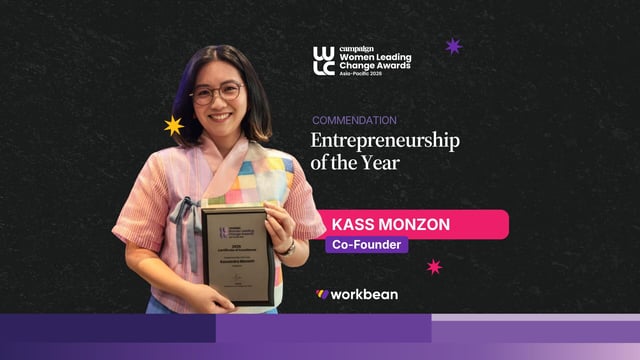
Workbean Co-Founder & CEO Kassandra Monzon earned a Commendation for Entrepreneurship of the Year at Campaign Asia-Pacific's Women Leading Change Awards (WLCA) Asia 2026. Here is how Workbean is reshaping employer branding in the Philippines.

Discover how 15 global and Philippine accounts master #CareerTok, and see why partnering with Workbean helps companies craft authentic, cringe-free short-form video strategies that attract top modern talent.

Ready to uncover your employer brand’s unique voice? Let’s talk →
- Sitemap
- Reach out
- Project Inquiry
Join Our Team


- Singapore
160 Robinson Road, #14-04 Singapore Business Federation Centre, 068914 Singapore
- Philippines
Unit 4D, 134, Building Jupiter, Makati City, 1209 Metro Manila