


Published April 22, 2026
Why Your EVP Isn't Working in the Philippines (And What to Do About It)
Employee Value Proposition
Employer Branding


Kass Monzon
Kass is the CEO and Co-Founder of Workbean, the Philippines’ first full-service employer branding agency. She builds bold, human-centered campaigns that help companies turn culture into a competitive advantage.
You spent months building your Employee Value Proposition. You ran focus groups, aligned leadership, polished the messaging, and rolled it out with a decent budget. And yet — the applications aren't converting the way they should. Your offer acceptance rate is lower than expected. Your best people are still leaving.
More often than not, the EVP isn't broken. It just hasn't been tailored to the specific motivations driving talent decisions in the Philippine market, and to the actual culture your employees experience from the inside. Those two things together are what make the difference between an EVP that looks good and one that actually performs.
At Workbean, the leading employer branding agency in the Philippines, we've worked with companies across industries — from homegrown conglomerates to multinational corporations establishing regional hubs here. And one of the most common things we see is an EVP that looks great on a global deck but lands flat with local talent.
This article breaks down why that happens — and what the best companies in the Philippines are doing differently.
The Copy-Paste Problem
Global employer branding frameworks are largely built on assumptions about what motivates talent that were validated in international hubs. These frameworks get exported to the Philippines with minimal adaptation: a translated tagline, local photography, and a Facebook post instead of just LinkedIn. Then companies wonder why nothing is moving.
The issue isn't effort. It's that no one stopped to ask what Filipino professionals actually say they want — based on real data, not assumptions.
The research tells a more specific story than most EVPs are built to address. Companies that close the gap between what they promise and what the local data actually shows are consistently winning on talent attraction and retention. The rest are spending on employer branding that doesn't connect.
What the Research Actually Says Filipino Talent Wants
This is where most EVPs fall apart: they're built on assumptions instead of evidence. Here's what leading research firms and talent surveys actually show about the Philippine workforce.
Stability and work-life balance are the top two non-negotiables. Jobstreet by SEEK's Decoding Global Talent Report found that 67% of Filipino talent prioritize a stable job with a good work-life balance above other factors. This isn't just a preference but a driver of decisions. An EVP that leads with innovation and disruption without first addressing stability is skipping what Filipino candidates care about most.
Two out of three Filipino employees are open to leaving — right now. A 2024 Aon survey across 23 countries found that 64% of Filipino workers are either actively looking for a new job or seriously considering it — putting the Philippines among the highest job-switching-intent markets globally. The implication for employer branding is clear: retention is not a passive outcome of a good culture. It requires an active, communicated value proposition that gives people a real reason to stay.
Career growth is the primary retention lever for Gen Z — and they're not being patient about it. 52% of Filipino Gen Z professionals cite growth opportunities as the main reason they stay with an employer. This is the generation now entering and rapidly advancing through your workforce. If your EVP isn't built around visible, credible pathways for development, you're not speaking to what actually keeps your youngest talent around.
Flexibility is no longer a perk — it's a baseline expectation. PwC's 2024 Global Workforce Hopes & Fears Survey found that only 21% of Filipino employees work full-time on-site, 52% in hybrid arrangements, and 27% fully remote. Meanwhile, 91% preferred either hybrid or fully remote setups. A return-to-office mandate without a compelling EVP rationale is one of the fastest ways to trigger attrition — and inflict lasting damage on your employer brand in the process.
Skills development is a consistent deal-maker. Jobstreet's data shows that 40% of Filipino employees are actively dedicating time each week to building their skills — focusing on analytical, creative, and job-specific capabilities. Talent here is self-investing. Companies whose EVPs reflect a genuine, specific commitment to reskilling and learning — not just a generic "we invest in our people" line — are significantly more attractive to this segment.
Compensation clarity still opens the door. Another survey confirms that Philippine companies are projecting average salary increases of 5.5% in 2025 in an intensely competitive compensation landscape. Pay alone doesn't win employer brand battles — but an EVP that avoids addressing compensation transparency signals that the company isn't serious about competing for talent.
Why Most Agencies Get This Wrong
Here's the uncomfortable truth: most employer branding work in the Philippines is done by agencies that take a global framework, swap in local faces, and call it localized. They produce beautiful output — but it's built on the wrong foundation.
Real localization starts with understanding what this market's data actually says, then building messaging and creative that addresses those specific drivers — not the ones that sounded right in a global brand workshop held somewhere else.
It also means understanding that the Philippine talent market is not monolithic. A mid-career finance professional in BGC is not making the same decision as a fresh engineering graduate in Cebu, or a tech specialist weighing a local offer against an international remote opportunity. The EVP that works needs enough specificity to reach the talent segment that actually matters to your business.
This is the kind of work that requires more than a template. It requires research, creative intelligence, and a team that understands both the strategy and the craft of employer brand building — in the Philippines, for the Philippines.
That's exactly what Workbean was built for.
Two Ways Workbean Helps You Solve This
Depending on where your company is in its employer branding journey, we have two core offerings designed for this:
EVP Locale™
For companies that already have an EVP, but need it to actually work in their local region.
EVP Locale™ is our localisation service for companies who've invested in a global employer brand but are seeing poor traction locally. We audit your existing EVP against the realities of the local talent market, like the Philippines, and identify the gaps between what you're communicating and what local talent actually responds to, and rebuild the messaging, creative direction, and channel strategy from the ground up.
The goal is to make your employer brand feel relevant to the specific candidates and employees who matter most to your business, in the market you're actually competing in.
EVP BuildUp™
For companies starting from scratch — or rebuilding after a reset.
If you don't have an EVP yet, or your current one needs to be scrapped and rebuilt, EVP BuildUp™ is our full-service employer brand development program. We do everything: talent research and employee listening, EVP architecture, creative development, messaging frameworks, and an activation roadmap that brings your brand to life across every touchpoint — from your careers page to your employee-generated content strategy.
This isn't a template exercise we apply to every client. It's original, research-backed, strategically grounded brand work — the kind that holds up when a candidate Googles you, when an employee talks about you at a reunion, and when your team has to wear the brand every single day.
The Cost of Getting It Wrong
A misaligned EVP doesn't just fail to attract talent, but it actively damages your employer brand. With 64% of Filipino employees open to leaving their current jobs, the window for employer brand errors is narrower than ever. Candidates who encounter an EVP that doesn't resonate don't just disengage — they form an impression of your company that persists long after they close the tab.
Filipino professionals are active on review platforms and talent communities. They compare notes. A brand that fails to address the things the data says actually matter — growth pathways, flexibility, stability, development — doesn't get a second chance at first impressions.
The good news? This is a fixable problem. And the fix starts with honesty about the gap between your current EVP and what the market needs to hear.
What Working With the Best Looks Like
Workbean is not just an employer branding agency. We are the Philippines' leading creative employer branding agency — and there's a meaningful distinction. We bring together brand strategy, market intelligence, and creative production under one roof, so you don't just get a well-reasoned EVP on paper. You get one that comes to life in video, design, content, campaigns, and the day-to-day experience of your people.
We've worked with some of the most recognized companies in the country — from global corporations building their Philippine employer brand for the first time, to local institutions rethinking how they compete for the next generation of Filipino talent.
Every engagement starts the same way: with listening. We talk to your people. We look at the data. We understand your competitive landscape. And then we build something that's true to who you are — and compelling to the talent you need.
Ready to Make Your EVP Actually Work?
If your employer brand isn't delivering results in the Philippines, the answer isn't to push harder on the same messaging. It's to go deeper — into data, into story, into what Filipino talent is actually telling us they want.
That's the magic of working with Workbean. That's what makes us the top employer branding agency in the Philippines.
Workbean is the Philippines' leading creative employer branding agency. We consult, design, and implement employer branding strategies that help companies become the place people can't wait to work for.
More interesting reads


In this article, Workbean’s co-founder, Neil Rojas explores the "Philippine Culture Trap"—why Philippine organizations struggle to accurately read their own internal culture and how structural, societal, and individual dynamics shape workplace reality.
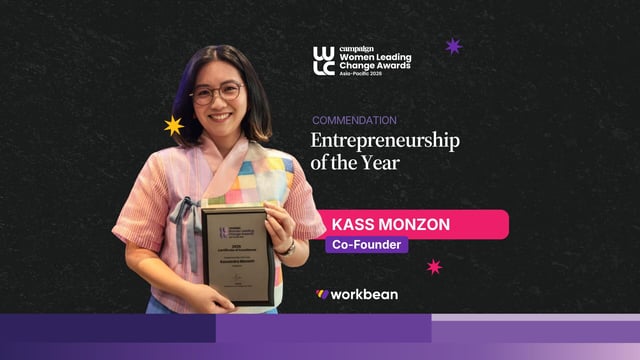
Workbean Co-Founder & CEO Kassandra Monzon earned a Commendation for Entrepreneurship of the Year at Campaign Asia-Pacific's Women Leading Change Awards (WLCA) Asia 2026. Here is how Workbean is reshaping employer branding in the Philippines.

Discover how 15 global and Philippine accounts master #CareerTok, and see why partnering with Workbean helps companies craft authentic, cringe-free short-form video strategies that attract top modern talent.

Ready to uncover your employer brand’s unique voice? Let’s talk →
- Sitemap
- Reach out
- Project Inquiry
Join Our Team


- Singapore
160 Robinson Road, #14-04 Singapore Business Federation Centre, 068914 Singapore
- Philippines
Unit 4D, 134, Building Jupiter, Makati City, 1209 Metro Manila