


Published August 3, 2026
Why Employer Brands Tank: The Gap Between Talk and Walk
Employer Branding
Employee Value Proposition


Neil Rojas
Neil is the Co-Founder and Head of Consulting at Workbean, the Philippines’ first full-service employer branding agency. He leads the building of bold, human-centered employer value proposition (EVP) projects that help companies turn culture into a competitive advantage.
Most branding talks are all about the "gloss"—the flashy career pages, high-end videos, and trendy taglines. But a real employer brand? It’s much deeper than marketing. It answers three questions candidates and employees constantly ask: Why did I sign up? Why am I busting my tail? and Why am I still here?.
When a brand fails, it’s usually because leadership confused their recruitment brochures with reality. If you want a workplace that keeps top talent, you need to look at the full architecture of your brand.
The Five Layers of a Killer Employer Brand
Think of a healthy employer brand as a stack of five distinct layers:
1. Foundation
This is your Vision, Mission, and Values. It’s the "who are we?" of your company. It works when leadership sets the tone, but it crumbles when those value statements on the wall have nothing to do with how people actually act.
2. Promise
The "Give vs. Get." This is the social contract. You offer rewards and growth; they offer talent and time. The danger? Over-promising shiny perks just to fill a seat today while setting yourself up for a turnover nightmare tomorrow.
3. Identity
Your look, your voice, your vibe. This is how you stand out in the talent market. But remember: a pretty brand book can’t fix a toxic culture. Don’t use polish to hide friction.
4. Activation
How you bring the brand to life through campaigns and onboarding. This is about converting interest into action. If your message changes at every touchpoint, candidates will notice the inconsistency instantly.
5. Measurement
The reality check. Are you actually doing what you said you’d do? Use pulse surveys and exit interviews to find the truth. If you aren’t measuring, you aren’t managing.
Too many companies stop after the fourth layer. They write the promise, design the logo, and blast the ads. But the fifth layer—Measurement—is where the cracks usually start to show.
Measurement depends on a three-part diagnostic: the Stated, Enabled, and Lived EVP. If you want to know why your brand is bleeding talent, you have to break it down like this.
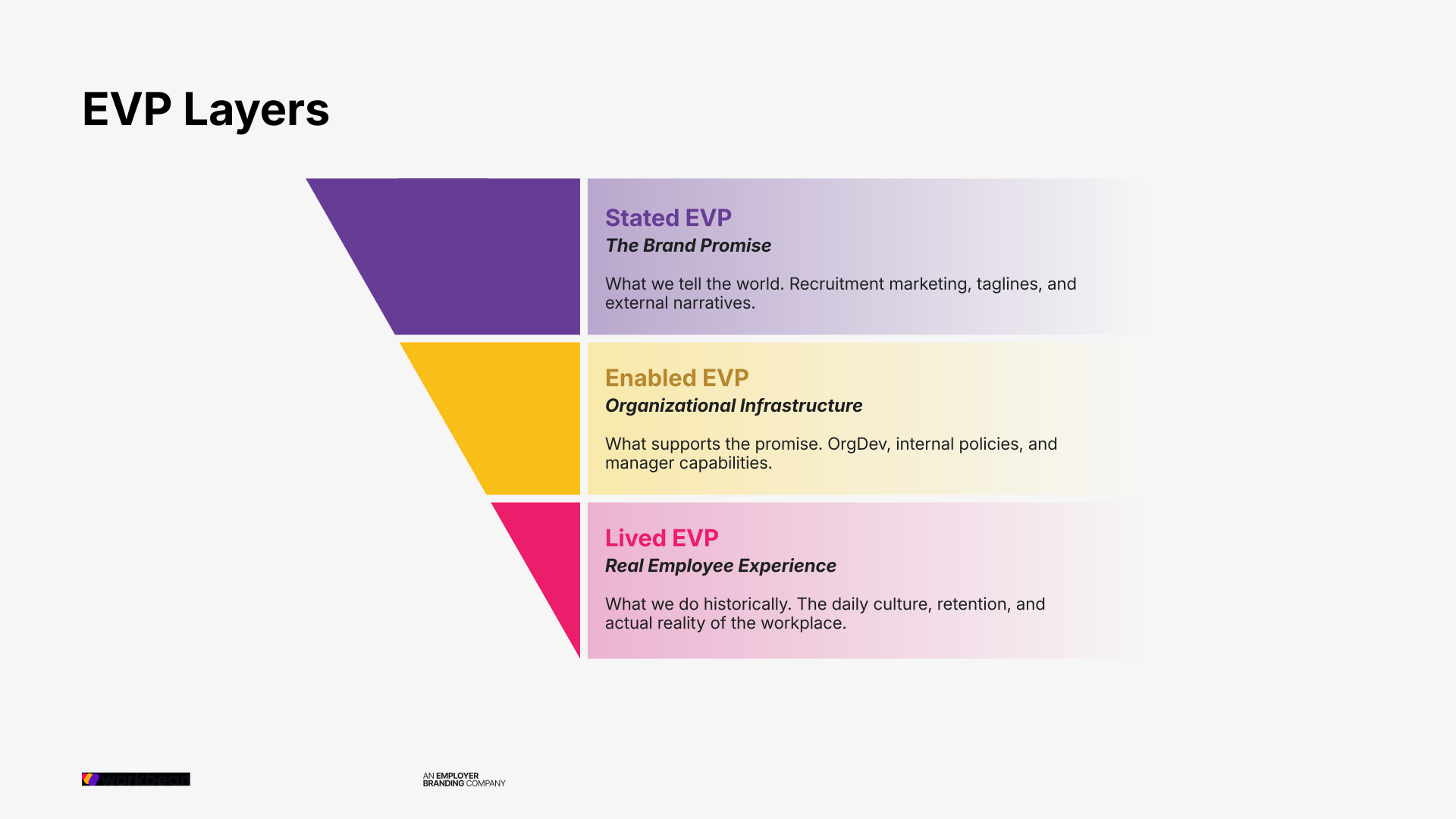
The Three-State EVP: A Diagnostic Reality Check
1. The Stated EVP: The Promise
The Stated EVP is your brand narrative. It is what you tell others.
This is the "hook." It’s external, led by Talent Acquisition and Corporate Communications, and focuses on conversion. But here’s the rub: if you treat this like a wishlist rather than a fact, you’re just setting up a bait-and-switch. When you promise "unlimited growth," that’s a contract. Candidates will expect you to deliver from day one.
But the Stated EVP is just a blueprint. Trouble starts when companies treat this state as a wishlist rather than a fact. If you claim to offer "limitless innovation," you are making a contract with the candidate. Once they sign the offer letter, they expect you to fulfill that promise.
2. The Enabled EVP: Organizational Infrastructure
The Enabled EVP is the bridge. It’s the infrastructure and policies that allow the brand to exist.
If Stated is the "talk," Enabled is the "walk." It’s about whether your Organization Development (OrgDev) and management effectiveness actually back up your claims. When this layer fails, you get structural paradoxes where your own rules kill your brand promise.
When this breaks down, you get operational paradoxes:
- The Talent Paradox: You claim to "only hire the best." But your recruiters are judged on speed, so you end up with mediocre hires because the system isn't built for quality.
- The Burnout Paradox: You sell "work-life balance," but your managers reward 60-hour weeks. The system forces overwork, and your promise is dead on arrival.
Leadership starts the fire, but middle managers keep it going. If your systems ignore your tagline, your brand is toast.
3. The Lived EVP: Real Employee Experience
The Lived EVP is the actual experience—what it’s really like in the trenches day-to-day.
Billboards don’t determine your culture—the things employees celebrate and endure do. When the experience matches the marketing, people stay. When they don’t, you get public backlash on Glassdoor and Reddit.
When the Lived EVP matches the Stated EVP, your employees become your best recruiters. When they don’t? Trust vanishes, and attrition spikes.
Diagnostic Metrics and Operations Reset Framework
Forget vanity metrics. If you want to know if your brand is healthy, you need to look at these four operational warning signs.
1. Compensation Bidding Wars
If you’re only winning talent by throwing more money at them, your brand has failed to communicate its value. This leaves you highly vulnerable to poaching.
2. The 90-day Cliff (or Quick Quitting)
When onboarding reality contradicts the recruitment pitch, people walk. This costs you a fortune in productivity and morale.
3. Glassdoor and Reddit Backlash
Negative reviews usually come from unfulfilled psychological contracts. If employees don’t have a voice inside, they’ll find one outside.
4. High Internal Transfer Friction
When management incentives lead to talent hoarding, your best people will go elsewhere to grow. Simple as that.
An effective employer brand reset follows a four-step diagnostic sequence:
1. Audit Authenticity: Benchmark job descriptions and career site copy against internal employee sentiment, exit interview data, Glassdoor reviews, and pulse surveys.
2. Formulate Aspiration: Define the target cultural direction over a 12-to-24-month horizon, signaling where organizational capabilities and leadership behaviors are heading.
3. Align Strategy with Talent: Connect the employer brand directly to long-term commercial goals, future skill requirements, and technological shifts.
4. Operationalize Infrastructure: Re-engineer OrgDev policies, performance evaluation systems, and onboarding workflows to mirror refreshed EVP pillars.
Closing the Loop
A real brand needs all layers to click. You can’t fix a broken Lived experience with a prettier marketing campaign. You fix it by repairing the infrastructure that supports it.
Ready to stop making empty promises and start building a culture that retains top talent? If you want Workbean to work on your employer brand architecture, reach out to us today.
Workbean is the Philippines' leading creative employer branding agency. We consult, design, and implement employer branding strategies that help companies become the place people can't wait to work for.
FAQs
Find the answer to commonly asked questions
What is the "Reputation Lag"?
How do we know if our Enabled EVP is failing?
Can a company have a strong Lived EVP but a weak Stated EVP?
More interesting reads


In this article, Workbean’s co-founder, Neil Rojas explores the "Philippine Culture Trap"—why Philippine organizations struggle to accurately read their own internal culture and how structural, societal, and individual dynamics shape workplace reality.

Workbean Co-Founder & CEO Kassandra Monzon earned a Commendation for Entrepreneurship of the Year at Campaign Asia-Pacific's Women Leading Change Awards (WLCA) Asia 2026. Here is how Workbean is reshaping employer branding in the Philippines.

Discover how 15 global and Philippine accounts master #CareerTok, and see why partnering with Workbean helps companies craft authentic, cringe-free short-form video strategies that attract top modern talent.

Ready to uncover your employer brand’s unique voice? Let’s talk →
- Sitemap
- Reach out
- Project Inquiry
Join Our Team


- Singapore
160 Robinson Road, #14-04 Singapore Business Federation Centre, 068914 Singapore
- Philippines
Unit 4D, 134, Building Jupiter, Makati City, 1209 Metro Manila