


Published August 11, 2026
The Advocacy Blueprint: How to Activate Your Team’s Voices Without the Corporate Cringe
Corporate Branding
Employer Branding Strategy


Kass Monzon
Kass is the CEO and Co-Founder of Workbean, the Philippines’ first full-service employer branding agency. She builds bold, human-centered campaigns that help companies turn culture into a competitive advantage.
In the age of perfectly curated corporate feeds, job seekers have developed a sixth sense for inauthenticity. When leadership insists "our culture is great," candidates scroll past. But when an engineer shares a candid, behind-the-scenes shot of a team breakthrough, or a designer drops an honest take on their first week, the narrative shifts instantly. Authentic, employee-driven storytelling isn't just content—it's the only remaining filter that cuts through the noise, offering candidates an unfiltered, human-scale view of what it’s actually like to work for you.
Job seekers trust an employee's perspective three times more than official corporate branding, and employee-generated content (EGC) shared on personal social accounts can generate significantly higher engagement than identical posts on formal company pages. The financial and strategic impact is substantial: organizations with active internal brand involvement see up to a 50% reduction in cost-per-hire and a 28% decrease in employee turnover. Furthermore, employee satisfaction directly fuels organizational output, with research showing that happy employees perform 12% better.
Despite these clear advantages, most employee ambassador programs fail. They collapse under the weight of scripted corporate copy, rigid Glassdoor approval bottlenecks, and mandatory participation—creating the exact "corporate cringe" that modern talent actively ignores.
The data proves it: 46% of Gen Z candidates use TikTok to vet company culture. They aren't looking at your job board; they're looking for an unfiltered window into your daily life.
Step 1: Fix the Foundation — Experience Precedes Advocacy
Stop trying to manufacture authenticity. Employee advocacy isn't a marketing hack; it's the byproduct of a culture people actually like. Look at Google’s "Project Aristotle": psychological safety—the freedom to be real without judgment—is what defines high-performing teams and fuels the best advocacy.
When the daily experience aligns with your brand promise, your team advocates for you naturally. They post, they refer, and they brag—not because you told them to, but because they're proud to be there. Advocacy happens when internal activation succeeds, not when you have a "better" content calendar.
If your program feels stalled, stop asking what to post. Start asking what you’re doing internally that’s actually worth talking about.
Step 2: Recruit Advocates (And Ditch "Voluntelling")
"Voluntelling" people to post leads to robotic, soul-sucking content that kills your credibility. You need willing, energized volunteers.
- Open an Opt-In Channel: Don’t assign advocacy to managers. Launch a simple sign-up form and find the people who already love sharing their stories.
- Value Their Energy: Storytelling takes work. Acknowledge the effort with perks, gift certificates, or public recognition from official brand accounts to show their impact matters.
- Start Small: Don’t go company-wide on day one. Pilot with a small group of ambassadors to refine your workflow and find your best story angles.
Step 3: Replace Scripts with Simple Guardrails
Giving employees a script to copy destroys trust immediately. Candidates spot corporate-speak from a mile away. It’s boring, and it doesn't work.
Swap the scripts for smart guardrails:
- Prompt, Don’t Dictate: Give ambassadors themes like "how we solve hard tech problems" or "my first week here." Let them use their own words.
- Set Clear Boundaries: Define the non-negotiables (confidentiality, code, respect). Then, step back. Give them creative freedom over their tone.
- Embrace the Real: No one wants flawless puff pieces. Real stories have nuance, challenges, and growth. That's what builds trust.
Step 4: Adopt Low-Blocker, Authentic Content Formats
High-budget commercials look staged. Unpolished, casual content wins because it feels relatable.
Focus your strategy on formats that match where your candidates are in their journey:
Short-Form Formats (For Attraction and Interest)
- Quick Q&A Videos: Rapid-fire answers to team myths or daily routines.
- "Tiny Mic" Snippets: Casual video tours or "day-in-the-life" workplace moments.
- Wins & Milestones: Authentic photos from project wrap-ups or team outings.
Long-Form Formats (For Consideration and Nuance)
- Employee Spotlights: Feature articles or podcasts diving into career growth and skill development.
- Technical Deep Dives: Case studies showing exactly how your team tackles complex hurdles.
Step 5: Build a Repeatable Execution and Repurposing Workflow
Keep storytelling easy. Build a pipeline that prevents burnout and keeps the momentum going.
The 5-Stage Advocacy Workflow: From Raw Insight to Brand Authority
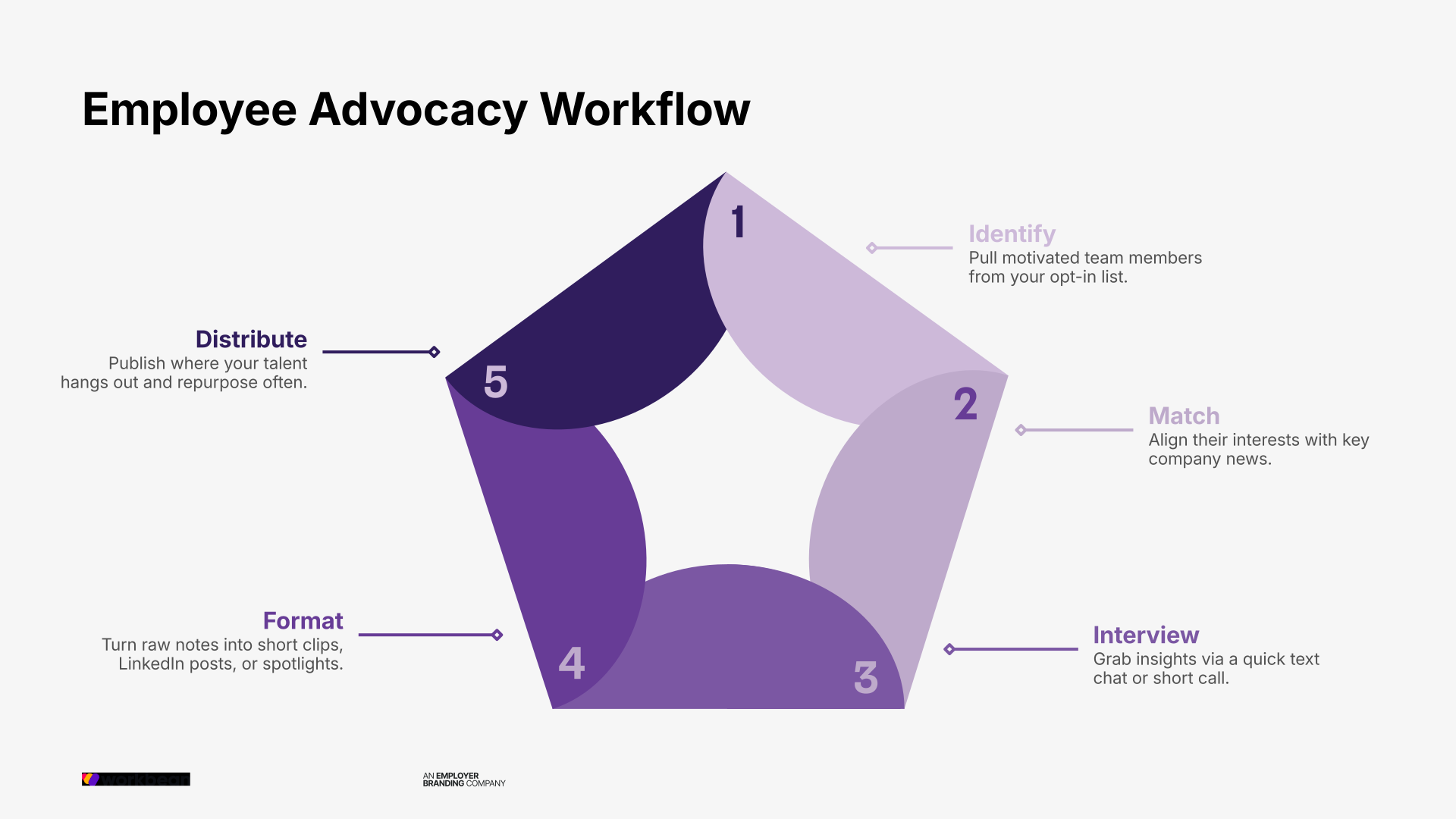
Stop treating employee advocacy like a mandatory marketing task. Treat it like a creative partnership. This workflow is designed to build momentum, respect your team’s time, and keep the storytelling authentic.
1. Identify
Build Your Volunteer Corps. Move beyond assigned participation. Create an "opt-in" channel where employees who are already passionate about your mission can raise their hands. By starting with a pool of genuine enthusiasts, you eliminate the need to manufacture interest and ensure that every piece of content is driven by authentic pride rather than obligation.
2. Match
Align Passion with Strategy. Context is king. Once you have your advocates, map their unique interests and roles to your current organizational goals, upcoming team projects, or brand narrative. This creates a win-win: the content directly supports your business objectives while remaining personally meaningful and engaging for the employee.
3. Interview
Master the Art of 'Low-Friction' Extraction. Stop formalizing storytelling. Your goal is to capture raw, human anecdotes without it feeling like an interrogation. Use "micro-interviews"—quick 15-minute syncs or text-based prompts that focus on capturing the 'human element'—the honest wins, the specific project challenges, and the personal reflections that resonate most with candidates.
4. Format
Transform Insights into Assets. This is where raw anecdote becomes polished content. Convert those gathered insights into diverse formats—LinkedIn thought-leadership posts, 'day-in-the-life' video snippets, or team spotlights. The key here is retention: preserve the employee’s original voice, perspective, and inflection. Avoid the trap of rewriting everything into standard corporate copy.
5. Distribute
Amplify, Don’t Just Post. Maximize the lifecycle of every story. Instead of a 'one-and-done' post, repurpose a single interview into a goldmine of assets: a primary social post, a newsletter excerpt, and internal company news. Crucially, always have the employee post from their personal account first to build genuine, social-first engagement. Only after that should the company page jump in to amplify and celebrate the contribution.
Don’t let a great story die. One interview can become a repurposed goldmine: LinkedIn posts, social clips, newsletter excerpts, and hiring brochures. Let your advocates post first, then use your company page to amplify and celebrate them.
Turning Vision into Action
A killer employer branding strategy is built on real experiences and unscripted storytelling. Ditch the rigid control, empower your people, and build a talent brand that candidates actually trust.
Authentic advocacy isn't a strategy you impose; it’s an experience you cultivate. By ditching the scripts and trusting your people to tell their own stories, you stop chasing talent and start attracting it.
Ready to ditch the cringe and build a real brand? Workbean helps you design volunteer-driven frameworks that actually work. Let’s turn your team’s voices into your competitive advantage—reach out today.
Workbean is the Philippines' leading creative employer branding agency. We consult, design, and implement employer branding strategies that help companies become the place people can't wait to work for.
FAQs
Find the answer to commonly asked questions
How do we get introverted or non-marketing employees involved in advocacy?
What should we do if an employee advocate leaves the company?
How do we measure the success of an employee-generated content program?
More interesting reads


Stop losing tenured talent to New Hire Envy. Learn how Workbean helps HR and Total Rewards leaders build an authentic, retention-first EVP.

Discover how respectful offboarding creates high-performing boomerang hires and lifelong brand advocates with Workbean.

In this article, Workbean’s co-founder, Neil Rojas explores the "Philippine Culture Trap"—why Philippine organizations struggle to accurately read their own internal culture and how structural, societal, and individual dynamics shape workplace reality.

Ready to uncover your employer brand’s unique voice? Let’s talk →
- Sitemap
- Reach out
- Project Inquiry
Join Our Team


- Singapore
160 Robinson Road, #14-04 Singapore Business Federation Centre, 068914 Singapore
- Philippines
Unit 4D, 134, Building Jupiter, Makati City, 1209 Metro Manila