


Published August 18, 2026
Command the Boardroom: Proving the Financial ROI of Your EVP
Employee Value Proposition


Neil Rojas
Neil is the Co-Founder and Head of Consulting at Workbean, the Philippines’ first full-service employer branding agency. He leads the building of bold, human-centered employer value proposition (EVP) projects that help companies turn culture into a competitive advantage.
HR leaders are hitting a recurring wall. You know a magnetic employer brand is the engine of growth, yet executive committees often dismiss it as a "creative" luxury—a marketing expense rather than a strategic asset. This disconnect is a business risk. When only 29% of functional leaders report having the talent they need to perform, your employer brand isn't just about fluff; it's about survival.
To win the budget you deserve, stop talking about culture in the abstract. You must reposition the Employee Value Proposition (EVP) as a hard financial driver. Your EVP is the definitive ROI mechanism used to attract and retain the elite talent your sector demands.
Executed correctly, an EVP is a high-yield investment that protects your bottom line. By utilizing hard metrics, you can mathematically demonstrate that a strong brand is a fiscal safeguard. A well-defined EVP aligns employees with your mission and vision, securing their long-term commitment and output.
Exposing the Financial Drain of a Weak Brand
To pitch ROI, you must first quantify the "Brand Tax." Without an authentic EVP, your company pays a premium on every hire. With employee engagement flatlining since 2016, these hidden costs are silently eroding your margins.
When candidates don't see value in your culture, salary becomes your only lever. This inflates your cost-per-hire immediately. Worse, a poor reputation doubles your sourcing time—a critical liability when only 23% of HR leaders expect long-term loyalty from their current workforce.
The Math of Retention: Protecting the Bottom Line
Investing in an employer brand is an investment in operational efficiency. By monitoring core metrics, you can track the fiscal health of your talent pipeline. Present these three metrics to your CFO:
1. Neutralizing the Compensation Premium
A strong EVP means you don't have to outbid the market. Candidates choose you for alignment, not just the paycheck. This reduces the compensation premium by 50%. It also expands your reach, allowing you to attract 50% more passive candidates who would otherwise be unreachable.
2. Maximizing Retention ROI
Turnover is a massive capital leak. A strategic employer brand plugs this hole, lowering annual turnover by up to 69%. When the lived experience matches the promise, trust is built instantly, increasing new hire commitment by 30%.
3. Scaling Profitability through Engagement
This isn't just about savings; it's about revenue. A compelling EVP attracts high-performers who hit targets faster. In fact, highly engaged teams boost profitability by 23% and customer loyalty by 10%.
Tracking Real Value
To defend your budget, you need to track metrics the C-suite cares about. Ditch vanity metrics like social media impressions. Instead, refine your EVP over time based on findings from a core executive dashboard:
- Candidate Net Promoter Score (cNPS): Measure the exact quality of your hiring process. Ask candidates how likely they are to recommend your organization based on their interview experience. A high cNPS means your external brand is working, which directly lowers your time-to-fill and agency spend.
- Early Attrition Rate (The 90-Day Cliff): Track how many new hires leave within their first 90 to 180 days. A spike here means your onboarding and lived reality broke the recruitment promise. Lowering early attrition saves massive sunk costs, directly improving your margins.
- Internal Mobility Rates: Track lateral and upward career moves. A strong EVP fosters career growth. When you fill roles internally, you skip external recruitment costs entirely and boost long-term retention.
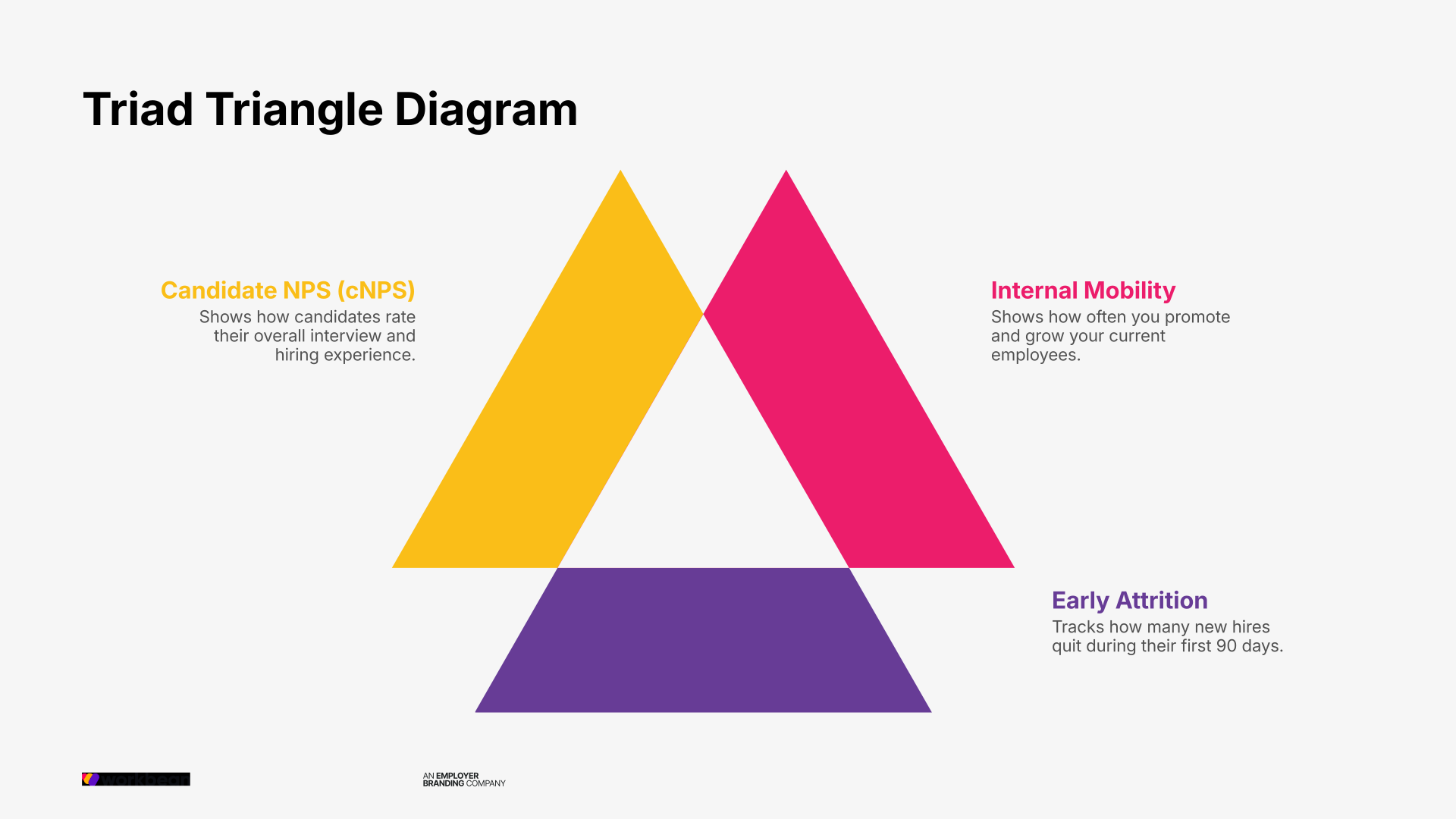
These three metrics do not operate in isolation; they are deeply interconnected. As visualized in the Triad Triangle Framework below, your Candidate NPS (external attraction), Early Attrition (initial retention), and Internal Mobility (long-term growth) fit together to form a comprehensive, data-driven picture of your employer brand's overall financial health.
The Business Case: Winning the Board
When presenting your budget, start with the math, not the concept. Align your brand directly with the company's financial objectives.
1. Audit Real Costs: Reveal the exact fiscal damage caused by regrettable turnover and agency fees last quarter.
2. Project Fiscal Gains: Apply the 69% turnover reduction metric to your current figures to project the capital saved over the next 12 months.
3. Position the Solution: Frame employer branding as a strategic mechanism to control labor costs and protect revenue. By proving how culture drives success, you demonstrate that HR is foundational to business longevity.
Culture is Capital
By mapping culture to cost-per-hire and turnover, you transform HR from a cost center into a profit driver. When you prove that talent protects margins, the CFO becomes your greatest ally. Business performance follows engagement. Stop asking based on feelings—secure it based on math.
Ready to architect an employer brand that commands executive buy-in? Contact Workbean today to measure and operationalize your EVP.
Workbean is the Philippines' leading creative employer branding agency. We consult, design, and implement employer branding strategies that help companies become the place people can't wait to work for.
FAQs
Find the answer to commonly asked questions
How do I quantify the cost of our current turnover?
Why is the candidate experience a boardroom priority?
What is the "Compensation Premium"?
Is employer branding only for tech giants?
More interesting reads


Stop losing tenured talent to New Hire Envy. Learn how Workbean helps HR and Total Rewards leaders build an authentic, retention-first EVP.

Discover how respectful offboarding creates high-performing boomerang hires and lifelong brand advocates with Workbean.

In this article, Workbean’s co-founder, Neil Rojas explores the "Philippine Culture Trap"—why Philippine organizations struggle to accurately read their own internal culture and how structural, societal, and individual dynamics shape workplace reality.

Ready to uncover your employer brand’s unique voice? Let’s talk →
- Sitemap
- Reach out
- Project Inquiry
Join Our Team


- Singapore
160 Robinson Road, #14-04 Singapore Business Federation Centre, 068914 Singapore
- Philippines
Unit 4D, 134, Building Jupiter, Makati City, 1209 Metro Manila