


Published July 22, 2022
Building Better Workplaces with Culture and Values Alignment
Company Culture

Let’s be honest: much of the talk about work today is about how to get out of it.
And that talk has caused many knots in the stomach of a team member, a manager, or an HR professional trying to deal with finding the right fit.
The past few years have given birth to what we like to call The Great Reconsideration. Employers, managers, and employees are rethinking their relationship with work, now that technology and recent events have given them the license to be more flexible or to be more flexible, as the case may be. It has inspired employees to look into workplace cultures and accommodations and employers to think about what they’re truly offering in terms of experiences.
While employees are seeking better compensation, more flexible work arrangements, and better management, employers are working to attract, recruit, and hire while balancing other key interests.
This begs the question: How can these two groups find common ground?
Creating a better work environment starts with shared values
How do we define shared values in the workplace? At Workbean, we believe that values aren’t just about what we’re trying to accomplish, they’re ultimately what we’re trying to become as we build, grow, and sustain an organization. They’re what we live by. And people might say that the disillusionment and wariness that is now felt at workplaces comes from the lack of clarity on values and how they’re lived out.
"As values serve as the pillars on how the business or organization should operate, there should be an alignment between the employer and employees as this would drive and guide them both in terms of how they will make and implement business decisions and processes."
Why is this important? “As values serve as the pillars on how the business or organization should operate, there should be an alignment between the employer and employees as this would drive and guide them both in terms of how they will make and implement business decisions and processes,” shares HR professional and life coach Sai Francisco-Capino.
She added, “Most companies and employees have this notion that values alignment is the responsibility of the HR, where in fact, it is everyone's concern and responsibility. To articulate and practice it, values alignment should start from the Visionary (who are usually the founders) as the champion, with the leadership team as co-champions and the rest of the team as the players. It means that every member of the organization should include the values in their work role or responsibility."
Once an organization is clear on its values it becomes easier to live them out and communicate them, be it to people inside or outside the organization. You can incorporate this communication early in the recruitment process and make it easier for both you and the prospective team member to find out if there’s an overlap. This makes it easier for the applicant to judge if you can give them the work experience that they’re looking for.
If your values are clear, it also makes it easier to impart them to a team member, especially during their first 3-6 months at the job, where they would benefit from having clear expectations and seeing the company live up to its word. This can go a long way to building trust and connection in the workplace.
Values alignment makes it easier to create programs that foster true engagement and support motivation at work
Companies are waking up to the fact that people have different demands when it comes to workplaces and work cultures. Some people need independence, others prefer having mentoring and coaching on hand, so knowing where employer values and team member values overlap can make it easier to uplift people.
It can also make it easier for the company to improve its budget allocation for HR initiatives and activities. Instead of going for ‘cool’ perks, HR can focus on perks like workshops to encourage lifelong learning, care kits for parents, or even coaching for promising employees who want to build their leadership capabilities or manage their time and energy better.
This can potentially open up other opportunities such as creating a team member rotation program to encourage people to learn from other departments and build relationships across the organization, adding other types of leaves to support employee wellbeing, and setting up healthier work boundaries, which would have a larger positive effect for employees without hurting budgets or productivity.
Being aligned on values can make it easier for employees to feel connected to the organization.
With how much time we spend at work, we should feel some level of connectedness to it. There’s nothing worse than feeling numb, bored, or disconnected from the work that we do—that only hurts our relationships, our output, and even our outlook on work. We don’t think it’s possible for people to feel creative or proactive when they would rather be anywhere else.
There’s growing literature on how to cultivate connectedness at work and why focusing on this can help people more engaged in their day-to-day work.
In a paper in the Organization Management Journal entitled “Motivating workers: how leaders apply self-determination theory in organizations,” Vivien Weisz Forner, Michael Jones, Yoke Berry, and Joakim Eidenfalk sought to uncover how leaders foster autonomy, competence, and relatedness in the workplace.
Weisz Forner, Jones, Berry, and Eidenfalk highlighted that some of the ways that leaders have cultivated connectedness in the workplace include learning about interests and backgrounds, which help build more authentic relationships.
Another way is to create opportunities for people to socialize. These can include your usual hangouts or departmental activities, but this can also include onboarding activities such as welcome events and even assigning buddies to help people get acclimated faster.
Lastly, Weisz Forner, Jones, Berry, and Eidenfalk also highlighted that leaders have focused on respecting others’ backgrounds and experiences to promote diversity and inclusion within their teams. Placing respect and value on each person’s strengths, differences, and perspectives—especially when this is done by leaders—can make people feel more included in the workplace and more connected to their teams and organizations as a result.
How else can we create connectedness in the workplace? In the book Exponential Organizations, Salim Ismail, Michael Malone, and Yuri Van Geest highlight that organizations can start with a Massive Transformative Purpose (MTP). What is the MTP? They describe the MTP as “the higher, aspirational purpose of the organization”. For them, it’s about making what seems impossible a reality through engagement, scaling, and technology, creating a cultural movement, community, and tangible products and services.
Ismail, Malone, and Van Geest note that a strong MTP can serve as a great recruitment pitch and a magnet for retaining your best people. Why? The book links the MTP to positive psychologist expert Martin Seligman’s three states of happiness, which notes that one state of happiness is in 'the meaningful life,' in finding purpose and working towards a common good. They suggest that the MTP can help organizations provide or enable this kind of happiness for their leaders and employees. With younger generations looking for more purpose-driven workplaces, the MTP provides another clue as to how organizations can connect with their people.
A great example of this in the book is TED, which runs TED Talks and now other similar events. Ismail, Malone, and Van Geest highlighted how TED’s MTP of “Ideas worth spreading” has not only attracted people who want to be on stage and share their ideas, theories, and learnings, but also a community of people who share in that love of lifelong learning, personal development, and growth. Now, TED’s community gets to organize its events, building relationships without prompting from the core team.
All of this points to a need to combine external and internal motivation. While employees may have different reasons for wanting to go to work, we need to show them where we have common ground and be clear on what they can expect.
Values alignment creates accountability
Sometimes, talk of values can make us uncomfortable. This is probably because it can feel like we’re talking about something abstract or subjective. It’s why organizations need to be open to these kinds of conversations and be willing to accept questions, especially at the recruitment stage. This can set the tone for a fruitful relationship with employees and encourage leaders to communicate with their people.
What does it look like when an organization lives out its values? Francisco-Capino talks about the importance of organizations sticking to their word and how it makes it easier for employees to demonstrate these values at work.
“If a company has "Integrity" value posted in their vision, mission, and values bulletin, the leadership or management team should show alignment of this value by practicing transparency, honesty in [the] formulation of processes and procedures, compliance to regulations (tax, permits) and others that related to other business transactions either internally or externally,” She shared. “From there, the rest of the team will continue implementing transparency, [and] compliance up to the smallest transactions. Once this is properly articulated, the messaging would be dishonesty in any form is not tolerated in the organization.”
She also talks about clearly articulating how these values are measured in the workplace. “As much as possible, indicators should be quantitative. If [it is] qualitative indicator, there should be a clear description about it.”
In one of her previous workplaces, service was important to the organization. Some of the ways that this value was measured included the number of unsolicited reviews from guests, consistent rankings on travel sites, the number of complaints, and the time it took to resolve an issue.
Francisco-Capino adds that this level of detail in measurement should also be applied internally. “Even for internal clients, there should be a measure of service. For example, the turnaround time for an HR to process a request from an employee (eg. Certificate of Employment for his/her loan application). The set around time should show service within the organization.”
Being aligned on values also gives employees autonomy and empowerment within the organization. If the organization is clear on its values and lives these out in a tangible way, employees will feel that they have ground to give their managers and leaders feedback. This can turn potential sources of conflict into opportunities for improvement and engagement.
For example, if your organization has identified care as a value, your employees can and should be encouraged to talk about whether they get good feedback, how easy it is to get time off work, or even whether or not they get emails and meeting invites beyond office hours. These are things that can be improved with communication, leadership, and consistency. Doing so would make your employees feel heard and included, and your leaders feel proactive and empathetic.
Being aligned on values ultimately creates an environment of respect, openness, and empathy. This is our first step to creating better workplaces.
“There should be a clear definition and mandate from the Visionary on the values of the company and alignment with the employees. [The] Leadership team should all be on board with the values of the company. They should be ready to champion the alignment,” said Francisco-Capino. “Team members should be open to understanding and fully embrace these values in their work life. There should be a commitment at all levels to ensure these values are articulated and practiced, not just posted on the bulletin boards or pantry or in the company's social media.”
If you want to create a positive, attractive work environment, one of the first things that you can do is to work with your leaders and identify your values. Second, you can work together to articulate those values and how you expect them to be lived out day to day at work. Lastly, be ready to communicate and maintain these values.
With these three steps, you can find the right people and help other people see why your organization is a good fit for them.
If you need help uncovering and communicating your future, reach out to the Workbean team through this website or our social media channels. We can help you and your team discover what makes you an attractive workplace and how you can attract employees and leaders who’d be a great culture fit for your company.

Kass Monzon
Co-founder and CEO of Workbean. She is an employer branding advocate who has helped organizations uncover stories of their workplace, people, and culture. In her free time, she takes care of her two naughty dogs named Orpheus and Loki while concocting new coffee recipes.


Discover how respectful offboarding creates high-performing boomerang hires and lifelong brand advocates with Workbean.

In this article, Workbean’s co-founder, Neil Rojas explores the "Philippine Culture Trap"—why Philippine organizations struggle to accurately read their own internal culture and how structural, societal, and individual dynamics shape workplace reality.
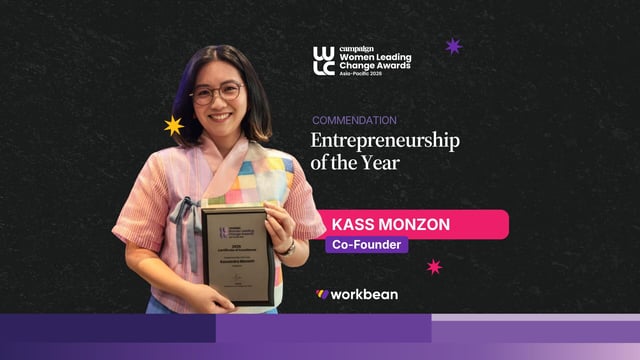
Workbean Co-Founder & CEO Kassandra Monzon earned a Commendation for Entrepreneurship of the Year at Campaign Asia-Pacific's Women Leading Change Awards (WLCA) Asia 2026. Here is how Workbean is reshaping employer branding in the Philippines.

Ready to uncover your employer brand’s unique voice? Let’s talk →
- Sitemap
- Reach out
- Project Inquiry
Join Our Team


- Singapore
160 Robinson Road, #14-04 Singapore Business Federation Centre, 068914 Singapore
- Philippines
Unit 4D, 134, Building Jupiter, Makati City, 1209 Metro Manila